Neurologic presentation unmasks arrhythmogenic channelopathy: KCNH2 variant Long-QT syndrome managed with subcutaneous implantable cardioverter-defibrillator. A case report
DOI:
https://doi.org/10.47487/apcyccv.v7i3.601Keywords:
Long QT Syndrome, Death, Sudden, Cardiac, Defibrillators, ImplantableAbstract
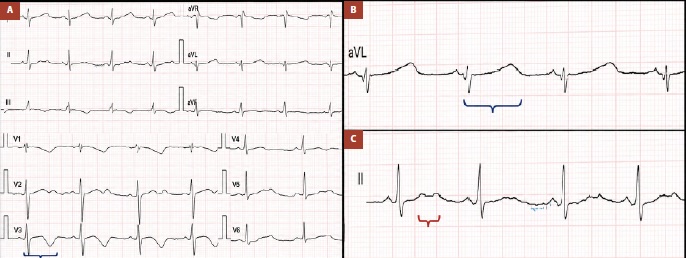
A previously healthy 10-year-old boy developed febrile seizure-like episodes after an appendectomy, which were diagnosed as epilepsy despite a normal electroencephalogram. He later presented with dyspnea and palpitations and was prescribed propafenone for frequent premature ventricular complexes. The electrocardiogram showed a markedly prolonged QTc interval of 550 ms with a notched T wave in lead V2. Phenytoin and propafenone were discontinued, and propranolol was initiated, but QTc prolongation persisted. The combination of severely prolonged QTc, characteristic T-wave morphology, and absence of structural heart disease redirected the diagnosis toward a repolarization channelopathy; genetic testing confirmed long-QT syndrome type 2 due to a pathogenic KCNH2 c.1814C>T variant. β-blocker therapy was optimized, QT-prolonging triggers were avoided, and a subcutaneous implantable cardioverter-defibrillator was implanted. Cascade genetic screening identified no additional KCNH2 carriers. One variant-negative sister had frequent idiopathic right ventricular outflow tract premature ventricular complexes and was referred for catheter ablation.
Downloads
References
Krahn AD, Laksman Z, Sy RW, Postema PG, Ackerman MJ, Wilde AAM, et al. Congenital long QT syndrome. JACC Clin Electrophysiol. 2022;8(5):687-706. doi: 10.1016/j.jacep.2022.02.017.
Ranganathan D, Grondin S, Hadjeres R, Joza J. Congenital long QT syndrome: a focus on risk stratification and management. Rev Cardiovasc Med. 2025;26(6):36779. doi: 10.31083/rcm36779.
Schwartz PJ, Crotti L. Long QT syndrome. N Engl J Med. 2025;393(20):2023-2034. doi: 10.1056/NEJMra2400853.
Zeppenfeld K, Tfelt-Hansen J, de Riva M, Winkel BG, Behr ER, Blom NA, et al. 2022 ESC guidelines for the management of patients with ventricular arrhythmias and the prevention of sudden cardiac death. Eur Heart J. 2022;43(40):3997-4126. doi: 10.1093/eurheartj/ehac262.
Zhu W, Bian X, Lv J. From genes to clinical management: a comprehensive review of long QT syndrome pathogenesis and treatment. Heart Rhythm O2. 2024;5(8):573-586. doi: 10.1016/j. hroo.2024.07.006.
Neves R, Bains S, Bos JM, MacIntyre C, Giudicessi JR, Ackerman MJ. Precision therapy in congenital long QT syndrome. Trends Cardiovasc Med. 2024 Jan;34(1):39-47. doi: 10.1016/j.tcm.2022.06.006.
Priori SG, Schwartz PJ, Napolitano C, Bloise R, Ronchetti E, Grillo M, et al. Risk stratification in the long-QT syndrome. N Engl J Med. 2003 May 8;348(19):1866-74. doi: 10.1056/NEJMoa022147.
Garson A Jr, Dick M 2nd, Fournier A, Gillette PC, Hamilton R, Kugler JD, et al. The long QT syndrome in children: an international study of 287 patients. Circulation. 1993 Jun;87(6):1866-72. doi: 10.1161/01. CIR.87.6.1866.
Hofman N, Wilde AA, Kääb S, van Langen IM, Tanck MW, Mannens MM, et al. Diagnostic criteria for congenital long QT syndrome in the era of molecular genetics: do we need a scoring system? Eur Heart J. 2007 Mar;28(5):575-80. doi: 10.1093/eurheartj/ehl355.
Wilde AAM, Amin AS, Postema PG. Diagnosis, management and therapeutic strategies for congenital long QT syndrome. Heart. 2022 Mar;108(5):332-338. doi: 10.1136/heartjnl-2020-318259.
Ono M, Burgess DE, Schroder EA, Elayi CS, Anderson CL, January CT, et al. Long QT syndrome type 2: emerging strategies for correcting class 2 KCNH2 (hERG) mutations and identifying new patients. Biomolecules. 2020 Aug 4;10(8):1144. doi: 10.3390/biom10081144.
Moss AJ, Zareba W, Kaufman ES, Gartman E, Peterson DR, Benhorin J, et al. Increased risk of arrhythmic events in long-QT syndrome with mutations in the pore region of the human ether-a-go-go-related gene potassium channel. Circulation. 2002 Feb 19;105(7):794-9. doi: 10.1161/hc0702.105124.
Anderson JH, Bos JM, Cascino GD, Ackerman MJ. Prevalence and spectrum of electroencephalogram-identified epileptiform activity among patients with long QT syndrome. Heart Rhythm. 2014 Jan;11(1):53-7. doi: 10.1016/j.hrthm.2013.10.010.
Ahn J, Kim HJ, Choi JI, Lee KN, Shim J, Ahn HS, et al. Effectiveness of beta-blockers depending on the genotype of congenital long-QT syndrome: a meta-analysis. PLoS One. 2017 Oct 23;12(10):e0185680. doi: 10.1371/journal.pone.0185680.
Mazzanti A, Trancuccio A, Kukavica D, Pagan E, Wang M, Mohsin M, et al. Independent validation and clinical implications of the risk prediction model for long QT syndrome (1-2-3-LQTS-Risk). Europace. 2022 Apr 5;24(4):614-619. doi: 10.1093/europace/euab238.
Wilde AAM, Semsarian C, Márquez MF, Shamloo AS, Ackerman MJ, Ashley EA, et al. European Heart Rhythm Association (EHRA)/Heart Rhythm Society (HRS)/Asia Pacific Heart Rhythm Society (APHRS)/ Latin American Heart Rhythm Society (LAHRS) expert consensus statement on the state of genetic testing for cardiac diseases. Europace. 2022 Sep 1;24(8):1307-1367. doi: 10.1093/europace/ euac030.
Schwartz PJ, Spazzolini C, Priori SG, Crotti L, Vicentini A, Landolina M, et al. Who are the long-QT syndrome patients who receive an implantable cardioverter-defibrillator and what happens to them?: data from the European Long-QT Syndrome Implantable Cardioverter-Defibrillator (LQTS ICD) Registry. Circulation. 2010 Sep 28;122(13):1272-82. doi: 10.1161/CIRCULATIONAHA.110.950147. 18. Lambiase PD, Eckardt L, Theuns DA, Betts TR, Kyriacou AL, Duffy E, et al. Evaluation of subcutaneous implantable cardioverterdefibrillator performance in patients with ion channelopathies from the EFFORTLESS cohort and comparison with a meta-analysis of transvenous ICD outcomes. Heart Rhythm O2. 2020 Oct 28;1(5):326- 335. doi: 10.1016/j.hroo.2020.10.002.
Schwartz PJ, Crotti L. QTc behavior during exercise and genetic testing for the long-QT syndrome. Circulation. 2011 Nov 15;124(20):2181-4. doi: 10.1161/CIRCULATIONAHA.111.062182.
Abrahams T, Davies B, Laksman Z, Sy RW, Postema PG, Wilde AAM, et al. Provocation testing in congenital long QT syndrome: a practical guide. Heart Rhythm. 2023 Nov;20(11):1570-1582. doi: 10.1016/j. hrthm.2023.07.059.
Downloads
Published
Issue
Section
License
Copyright (c) 2026 The journal is headline of the first publication, then the author giving credit to the first publication.

This work is licensed under a Creative Commons Attribution 4.0 International License.