One patient, three arrhythmias. Case report
DOI:
https://doi.org/10.47487/apcyccv.v7i2.599Keywords:
Atrial Flutter, Atrioventricular Nodal Reentry Tachycardia, Atrial Septal Defect, Catheter AblationAbstract
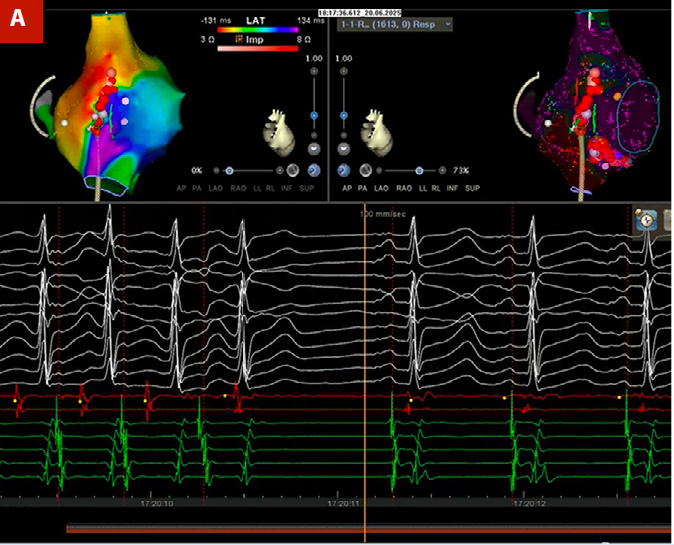
Postoperative patients with congenital heart disease can develop more than one arrhythmia because of underlying anatomical abnormalities and postsurgical scarring. Atrial flutter is by far the most common arrhythmia in this population, and catheter ablation is the preferred treatment. After successful ablation, induction manoeuvres are important to identify additional macro-reentrant circuits. We report the case of a 55-year-old woman with a history of surgical repair of an atrial septal defect who underwent electrophysiological study and ablation of atrial flutter using a three-dimensional mapping system, with zero fluoroscopy and intracardiac echocardiography. During the procedure, three distinct arrhythmias were identified (two atrial flutters and atrioventricular nodal re-entrant tachycardia). All were successfully ablated in the same procedure.
Downloads
References
Hernández-Madrid A, Paul T, Abrams D, Aziz PF, Blom NA, Chen J, et al. Arrhythmias in congenital heart disease: a position paper of the European Heart Rhythm Association (EHRA), Association for European Paediatric and Congenital Cardiology (AEPC), and the European Society of Cardiology (ESC) Working Group on Grown-up Congenital Heart Disease, endorsed by HRS, PACES, APHRS, and SOLAECE. Europace. 2018;20(11):1719-1753. doi: 10.1093/europace/eux380.
Francisco-Pascual J, Mallofré Vila N, Santos-Ortega A, RivasGándara N. Tachyarrhythmias in congenital heart disease. Front Cardiovasc Med. 2024;11:1395210. doi: 10.3389/fcvm. 2024.1395210.
Waldmann V, Bessière F, Raimondo C, Maltret A, Amet D, Marijon E, et al. Atrial flutter catheter ablation in adult congenital heart diseases. Indian Pacing Electrophysiol J. 2021;21(5):291-302. doi: 10.1016/j.ipej.2021.06.003.
Waldmann V, Guichard JB, Marijon E, Khairy P. Tachyarrhythmias in Congenital Heart Diseases: From Ion Channels to Catheter Ablation. J Cardiovasc Dev Dis. 2022;24;9(2):39. doi: 10.3390/ jcdd9020039.
Waldmann V, Hebe J, Walsh EP, Khairy P, Ernst S. Catheter Ablation of Atrioventricular Nodal Reentrant Tachycardia in Patients With Congenital Heart Disease. Circ Arrhythm Electrophysiol. 2022;15(2):e010631. doi: 10.1161/CIRCEP.121.010631.
Soulaidopoulos S, Brili S, Drakopoulou M, Sotiropoulos I, Archontakis S, Dilaveris P, et al. Catheter ablation in grown-up congenital heart disease patients: A single-center experience. Int J Cardiol Congenit Heart Dis. 2022;7:100326. doi: 10.1016/j. ijcchd.2022.100326.
Interian A Jr, Cox MM, Jiménez RA, Duran A, Levin E, García O, et al. A shared pathway in atrioventricular nodal reentrant tachycardia and atrial flutter: implications for pathophysiology and therapy. Am J Cardiol. 1993;71(4):297-303. doi: 10.1016/0002- 9149(93)90794-d.
Lin CH, Lin YJ, Chang SL, Lo LW, Huang HK, Chiang CH, et al. Novel electrophysiological characteristics of atrioventricular nodal continuous conduction curves in atrioventricular nodal re-entrant tachycardia with concomitant cavotricuspid isthmus-dependent atrial flutter. Europace. 2016;18(8):1259-64. doi: 10.1093/europace/euv345.
Varela DL, Rosenberg MA, Borne RT, Sandhu A, Zipse MM, Tzou WS, et al. Increased incidence of cavotricuspid isthmus atrial flutter following slow pathway ablation. J Interv Card Electrophysiol. 2022;63(3):581-589. doi: 10.1007/s10840-021- 01065-0.
Downloads
Published
Issue
Section
License
Copyright (c) 2026 The journal is headline of the first publication, then the author giving credit to the first publication.

This work is licensed under a Creative Commons Attribution 4.0 International License.