Long RP tachycardia: a diagnostic challenge. A case report
DOI:
https://doi.org/10.47487/apcyccv.v7i2.627Palabras clave:
Tachycardia, Supraventricular, Cardiac Electrophysiologic Techniques, Radiofrequency Ablation, Reciprocal TachycardiaResumen
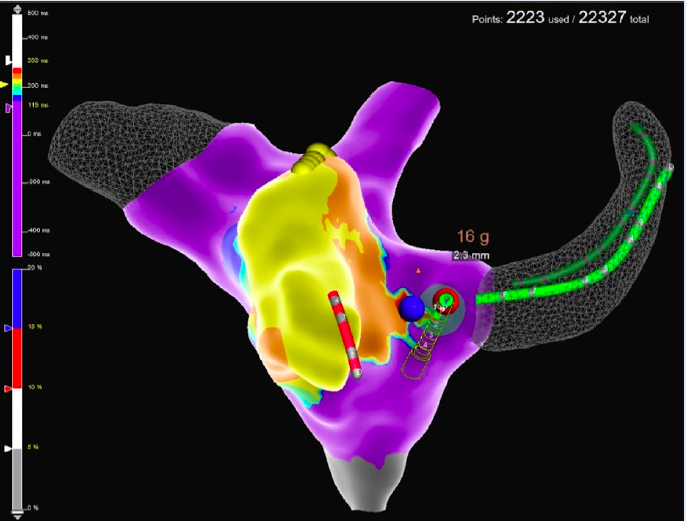
Permanent junctional reciprocating tachycardia (PJRT), also known as Coumel tachycardia, is a rare form of supraventricular tachycardia predominant in children and classically associated with tachycardiainduced cardiomyopathy. Its occurrence in adults is uncommon, and recurrence after a previously failed conventional ablation is even less frequently reported. We report the case of a 33-year-old woman with palpitations since childhood. At 12 years of age, she underwent a conventional electrophysiological study with radiofrequency ablation. However, symptoms persisted, requiring multiple antiarrhythmic drugs and frequent emergency department visits with only partial control, prompting a redo procedure. On this occasion, three-dimensional electroanatomical mapping with the “open-window” technique was used. During the procedure, orthodromic reciprocating tachycardia (ORT) using a right posteroseptal occult accessory pathway with decremental retrograde conduction was diagnosed. Radiofrequency ablation of the accessory pathway was successful, with a favorable clinical outcome at follow-up. Coumel tachycardia is an unusual type of supraventricular tachycardia, even more so in adults. The diagnostic approach begins with the electrocardiogram and extends to invasive methods such as electroanatomical mapping, which enable precise characterization of the arrhythmic substrate.
Descargas
Referencias
Coumel P. Junctional reciprocating tachycardias. The permanent and paroxysmal forms of A-V nodal reciprocating tachycardias. J Electrocardiol. 1975 Jan;8(1):79–90. doi:10.1016/S0022- 0736(75)80043-4
Kylat RI, Samson RA. Permanent junctional reciprocating tachycardia in infants and Children. J Arrhythmia. 2019 Jun;35(3):494–8. doi:10.1002/joa3.12193
Michaud GF, Tada H, Chough S, Baker R, Wasmer K, Sticherling C, et al. Differentiation of atypical atrioventricular node re-entrant tachycardia from orthodromic reciprocating tachycardia using a septal accessory pathway by the response to ventricular pacing. J Am Coll Cardiol. 2001 Oct;38(4):1163–7. doi:10.1016/S0735- 1097(01)01480-2
Wang NC. Open‐window mapping and the extended early‐meets‐ late algorithm for the Wolff-Parkinson-White syndrome. J Arrhythmia. 2022 Aug;38(4):642–5. doi:10.1002/joa3.12726
Sande JLM, Minguito-Carazo C, Gonzalez-Melchor L, Garcia-Seara J, Rodriguez-Manero M, Martinon-Martinez J, et al. High-density open window mapping vs conventional mapping in accessory pathways ablation. Eur Heart J. 2023;44(Suppl 2):ehad655.368.
Meiltz A, Weber R, Halimi F, Defaye P, Boveda S, Tavernier R, et al. Permanent form of junctional reciprocating tachycardia in adults: peculiar features and results of radiofrequency catheter ablation. EP Eur. 2006 Jan 1;8(1):21–8. doi:10.1093/europace/euj007
Galvão RDC, Pucci JPV, Vieira OG. Atypical location of Coumel Tachycardia in Adult: Case Report. J Card Arrhythm. 2020 Nov 6;33(3):170–5. doi:10.24207/jca.v33i3.3398
Okada M, Mizutani A, Tanaka K, Tanaka N. Delineating multiple septal accessory pathways using open-window mapping with a novel multispline mapping catheter. Hear Case Rep. 2024 Mar;10(3):238–40. doi:10.1016/j.hrcr.2023.12.010
Descargas
Publicado
Número
Sección
Licencia
Derechos de autor 2026 La revista es titular de la primera publicación, luego el autor dando crédito a la primera publicación.

Esta obra está bajo una licencia internacional Creative Commons Atribución 4.0.