Prediction of major adverse cardiovascular events with two risk scales for acute chest pain in the emergency department
DOI:
https://doi.org/10.47487/apcyccv.v6i4.555Keywords:
Chest Pain, Cardiovascular Diseases: Forecasting, DiagnosisAbstract
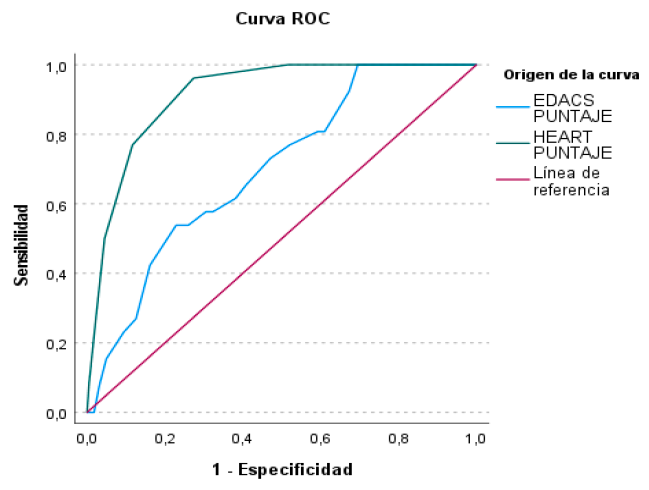
Objectives. To compare the ability of the HEART and EDACS scores to predict major adverse cardiovascular events (MACE) at 30 days of follow-up in patients with acute chest pain presenting to an emergency department. Materials and Methods. Retrospective study of patients older than 18 years treated for acute chest pain, excluding ST-elevation acute coronary syndrome (ACS), trauma, and infections. The HEART and EDACS scores were assessed at admission. The area under the receiver operating characteristic curve (AUC), sensitivity, specificity, positive predictive value, and negative predictive value of both scores were calculated for the prediction of 30-day MACE. Results. A total of 249 patients were evaluated; 62.2% were male, with a mean age of 66.5 years. There were 25 MACEs (10%). The HEART score classified patients as low risk (43.4%), moderate risk (47.4%), and high risk (9.2%). Using the EDACS, patients were classified as low risk (38.6%) and not low risk (61.4%). Regarding MACE, the HEART score had an AUC of 0.91 (95% CI: 0.87–0.95) and EDACS had an AUC of 0.70 (95% CI: 0.60–0.79). For the diagnosis of ACS, the HEART score had an AUC of 0.85 (95% CI: 0.78–0.92) and EDACS 0.64 (95% CI: 0.55–0.72). The HEART score demonstrated better performance than EDACS, especially when a score ≥4 was obtained. Conclusions. The HEART score has higher diagnostic performance than EDACS for predicting MACE in patients with acute chest pain presenting to a tertiary emergency department.
Downloads
References
Market D, Marill KA, Schmidt A. Identifying Emergency Department Patients With Chest Pain Who Are at Low Risk for Acute Coronary Syndrome. Emerg Med Pract. 2017;19(7):2-21.
Byrne RA, Rossello X, Coughlan JJ, Barbato E, Berry C, Chieffo A, et al. 2023 ESC Guidelines for the management of acute coronary syndromes: Developed by the task force on the management of acute coronary syndromes of the European Society of Cardiology (ESC), European Heart Journal 2023;44(38):3720-3826. doi: 10.1093/eurheartj/ehad191.
Instituto de Evaluación de Tecnologías en Salud e Investigación (IETSI). Guía de Práctica Clínica de Síndrome Isquémico Coronario Agudo. Guía en Versión Corta. GPC N°4. Lima: EsSalud; 2017.
Gulati M, Levy PD, Mukherjee D, Amsterdam E, Bhatt DL, Birtcher KK, et al. 2021 AHA/ACC/ASE/CHEST/SAEM/SCCT/ SCMR Guideline for the Evaluation and Diagnosis of Chest Pain: A Report of the American College of Cardiology/ American Heart Association Joint Committee on Clinical Practice Guidelines. Circulation. 2021;144(22):e368-e454. doi: 10.1161/CIR.0000000000001029.
Liu TY, Tsai MT, Chen FC, Pan HY, Huang JB, Cheng FJ, et al. Impact of coronary risk scores on disposition decision in emergency patients with chest pain. Am J Emerg Med. 2021;48:165-169. doi: 10.1016/j.ajem.2021.04.029.
Halder D, Mathew R, Jamshed N, Yadav S, Rl B, Aggarwal P, et al. Utility of HEART Pathway in Identifying Low-Risk Chest Pain in Emergency Department. J Emerg Med. 2021;60(4):421-427. doi: 10.1016/j.jemermed.2020.12.004.
Kim MJ, Ha SO, Park YS, Yi JH, Yang WS, Kim JH. Validation and modification of HEART score components for patients with chest pain in the emergency department. Clin Exp Emerg Med. 2021;8(4):279-288. doi: 10.15441/ceem.20.106.
Boyle RSJ, Body R. The Diagnostic Accuracy of the Emergency Department Assessment of Chest Pain (EDACS) Score: A Systematic Review and Meta-analysis. Ann Emerg Med. 2021;77(4):433-441. doi: 10.1016/j. annemergmed.2020.10.020.
Reynolds HR, Shaw LJ, Min JK, Spertus JA, Chaitman BR, Berman DS, et al. Association of Sex With Severity of Coronary Artery Disease, Ischemia, and Symptom Burden in Patients With Moderate or Severe Ischemia: Secondary Analysis of the ISCHEMIA Randomized Clinical Trial. JAMA Cardiol. 2020;5(7):773-786. doi: 10.1001/jamacardio.2020.0822.
Ríos P, Pariona M, Urquiaga JA, Mendez FJ. Características clínicas y epidemiológicas del infarto de miocardio agudo en un hospital peruano de referencia. Rev Perú Med Exp Salud Publica. 2020;37(1):74-80. doi: 10.17843/ rpmesp.2020.371.4527.
Quezada-Pinedo HG, Ahanchi NS, Cajachagua-Torres KN, ObesoManrique JA, Huicho L, Gräni C, et al. A comprehensive analysis of cardiovascular mortality trends in Peru from 2017 to 2022: Insights from 183,386 deaths of the national death registry. Am Heart J Plus. 2023;35:100335. doi: 10.1016/j.ahjo.2023.100335.
Navea O, Tapia V, Maluenda F, Miguel A. Estratificación de riesgo del dolor torácico en el servicio de urgencia. ARS Med (Santiago). 2023;48(3):48-61. doi: 10.11565/arsmed.v48i3.1921. 13. Poldervaart JM, Langedijk M, Backus BE, Dekker IMC, Six AJ, Doevendans PA, et al. Comparison of the GRACE, HEART and TIMI score to predict major adverse cardiac events in chest pain patients at the emergency department. Int J Cardiol. 2017;227:656-661. doi: 10.1016/j.ijcard.2016.10.080.
Six AJ, Cullen L, Backus BE, Greenslade J, Parsonage W, Aldous S, et al. The HEART score for the assessment of patients with chest pain in the emergency department: a multinational validation study. Crit Pathw Cardiol. 2013;12(3):121-126. doi: 10.1097/HPC.0b013e31828b327e.
Nilsson T, Johannesson E, Lundager J, Mokhtari A, Ekelund U. Diagnostic accuracy of the HEART Pathway and EDACSADP when combined with a 0-hour/1-hour hs-cTnT protocol for assessment of acute chest pain patients. Emerg Med J. 2021;38:808–813. doi: 10.1136/emermed-2020-210833.
Chacón-Diaz M, Salinas J, Doig R. Estratificación del dolor torácico con el score HEART modificado y su relación con eventos adversos cardiovasculares a corto plazo. Arch Cardiol Mex. 2018;88(5):333-338. doi: 10.1016/j.acmx.2017.06.008.
Mahler SA, Stopyra JP, Apple FS, Riley RF, Russell GB, Hiestand BC, et al. Use of the HEART Pathway with high sensitivity cardiac troponins: A secondary analysis. Clin Biochem. 2017;50(7- 8):401-407. doi: 10.1016/j.clinbiochem.2017.01.003.
Pérez M, Satústegui PJ, Benito E, Solans A, Fernández MT. Comparación de las escalas Heart, Grace Score y los parámetros clínicos como predictores de eventos cardiovasculares en pacientes con dolor torácico en Urgencias. Rev Esp Salud Publica. 2023;97:e202312102
Than M, Flaws D, Sanders S, Doust J, Glasziou P, Kline J, et al. Development and validation of the Emergency Department Assessment of Chest pain Score and 2 h accelerated diagnostic protocol. Emerg Med Australas. 2014;26(1):34-44. doi: 10.1111/1742-6723.12164.
Stopyra J, Snavely AC, Hiestand B, Wells BJ, Lenoir KM, Herrington D, et al. Comparison of accelerated diagnostic pathways for acute chest pain risk stratification. Heart. 2020;106(13):977-984. doi: 10.1136/heartjnl-2019-316426.
Fernando SM, Tran A, Cheng W, Rochwerg B, Taljaard M, Thiruganasambandamoorthy V, et al. Prognostic Accuracy of the HEART Score for Prediction of Major Adverse Cardiac Events in Patients Presenting With Chest Pain: A Systematic Review and Meta-analysis. Acad Emerg Med. 2019;26(2):140- 151. doi: 10.1111/acem.13649.
Downloads
Published
Issue
Section
License
Copyright (c) 2025 The journal is headline of the first publication, then the author giving credit to the first publication.

This work is licensed under a Creative Commons Attribution 4.0 International License.